Why a Like Feels Like Acceptance

By J. Atkins | Developmental Scientist + Behavior Analyst

The Refresh
A 14-year-old posts a photo before dinner. By dessert, they have checked it a dozen times. Twelve likes. Then nineteen. Then a long, quiet stretch that feels, to them, like a verdict. As a developmental scientist and behavior analyst, I hear versions of this story from parents all the time. The question underneath it is always the same. Why does a tap on a heart icon feel so much like being accepted, and why does its absence sting so much like being left out?
This is not a niche worry. In Pew Research Center's 2024 survey of 1,391 U.S. teens, 46% said they are online almost constantly. So I went to the research to sort out what we know, what we only suspect, and what parents can actually do. The short version: likes tap a need to belong that is especially strong in adolescence, and they arrive on a schedule that is close to perfectly designed to keep us checking. But the evidence on harm is more mixed than the headlines suggest.
Key findings at a glance
Likes light up reward | In a UCLA brain-scan study, teens' own photos with many likes activated the brain's reward circuitry. |
Frequent checkers grow more sensitive | Kids who checked social media more than 15 times a day became more sensitive to peer feedback over three years. Whether checking caused it is not yet clear. |
Likes work like a slot machine | Unpredictable rewards keep us checking, and in one experiment more likes led people to post more often. |
Harm is real but modest on average | Risk concentrates in patterns like appearance comparison, lost sleep and compulsive checking, and patterns can change. |
What a like does in the teenage brain
The most cited study here comes from UCLA. In 2016, Lauren Sherman and colleagues built a mock Instagram feed and scanned 32 teenagers, ages 13 to 18, while they scrolled it. Some of the photos were the teens' own. The researchers secretly assigned each photo either many likes (23 to 45) or few (0 to 22). Two findings stand out. When teens saw their own photos with many likes, the nucleus accumbens, a hub of the brain's reward circuitry, was more active. And teens were more likely to like a photo themselves when it already had lots of likes, even photos showing risky behavior like drinking. Viewing risky photos was also linked to lower activity in regions involved in cognitive control.
It was a small lab study with made-up-like counts, so treat it as a window, not a verdict. A larger study followed kids over time. Maza and colleagues (2023) scanned 169 sixth and seventh graders in rural North Carolina once a year for three years. Kids who checked Facebook, Instagram and Snapchat more than 15 times a day became increasingly sensitive to anticipated social feedback, while kids who rarely checked became less so. The authors are careful: they cannot say whether checking caused the change or whether kids who were already wired differently checked more. They also note that heightened sensitivity could be problematic for some youth and adaptive for others.
This fits what the American Psychological Association says about development. Brain regions tied to wanting attention, feedback and reinforcement from peers become more sensitive starting in early adolescence, while the regions that support mature self-control keep developing into adulthood.
Put simply, the accelerator matures before the brakes.
Belonging, comparison and the fear of missing out
Humans are built to care about belonging, and adolescence is when peer acceptance moves to the center of a young person's world. Before social media, acceptance was mostly felt and inferred. A like makes it visible, public and countable. That is a big change for a developing mind. Countable acceptance invites comparison. The APA advisory warns that comparing appearance online, and paying excessive attention to one's own photos and the feedback on them, are linked to poorer body image, disordered eating and depressive symptoms, particularly among girls. It recommends that teens limit use for beauty and appearance content.
Then there is the fear of missing out. Przybylski and colleagues (2013) defined it as "a pervasive apprehension that others might be having rewarding experiences from which one is absent." Across three studies, people whose basic needs for competence, autonomy and connection were less satisfied reported more FOMO, and more FOMO went with more social media engagement. In their student sample, FOMO predicted checking Facebook during lectures and even while driving.
The same feed that fuels comparison can also deliver real belonging. The 2023 Surgeon General's advisory cites survey data in which 58% of adolescents said social media helps them feel more accepted, and 67% said it connects them with people who can support them through tough times. For marginalized youth especially, online community can be a buffer. Likes are not the enemy. The question is what they are standing in for.
The behavior-analytic lens: why we keep checking
Here is where my second hat comes in. In behavior analysis, a like is a reinforcer: a consequence that makes the behavior before it more likely to happen again. What matters most is not the like itself but the schedule it arrives on. Likes come intermittently and unpredictably. Sometimes a post gets a flood, sometimes a trickle, sometimes nothing for an hour. Since Ferster and Skinner's work on schedules of reinforcement, we have known that unpredictable schedules produce high, steady rates of responding that are stubborn to extinguish.
A slot machine pays off after an unpredictable number of pulls. A notification feed pays off after an unpredictable stretch of time. Either way, the next check might be the one that pays, so we keep checking.
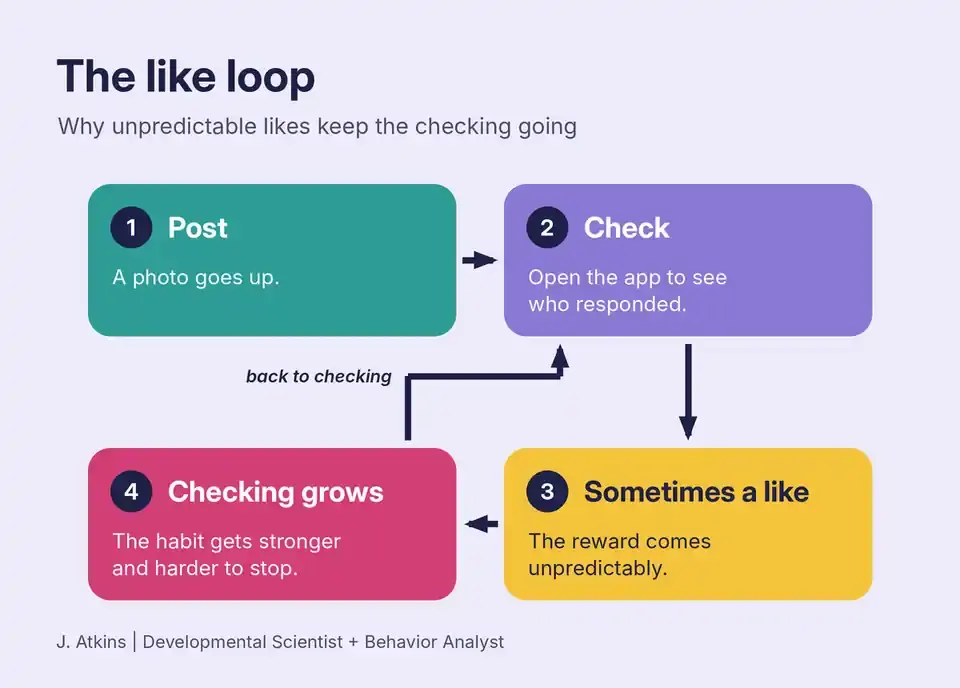
This is not just an analogy. Lindström and colleagues (2021) analyzed more than one million posts from over 4,000 people on Instagram and other platforms. People spaced their posts in a way that tracked the rate of likes they received, the same pattern reward-learning models predict for animals working for food. In a follow-up experiment with 176 participants on a mock platform, more likes caused people to post more often. The authors described the online world as "a Skinner Box for the modern human."
Two behavioral ideas are useful for parents here:
Function: every repeated behavior serves a purpose. Checking may produce approval, relief from boredom, or escape from an anxious feeling. The fix depends on which one.
Extinction bursts: when a reinforcer suddenly drops off, behavior often spikes before it fades. A teen who posts and gets little response may check more, not less, for a while. That is predictable, not a sign that something is broken.
What the evidence does and does not show
It would be easy to stop here and declare likes harmful. The research does not let us. On one side, a Johns Hopkins study (Riehm et al., 2019) followed 6,595 U.S. adolescents and found that those using social media more than three hours a day were more likely to report internalizing problems, such as anxiety and depression symptoms, a year later. The Surgeon General's advisory describes this as double the risk. Yet the lead author was direct: "We cannot conclude that social media causes mental health problems."
On the other side, Orben and Przybylski (2019) analyzed data from 355,358 adolescents and found the link between digital technology use and well-being was negative but small, explaining at most 0.4% of the variation in well-being. The major bodies land in the middle. The APA says social media is "not inherently beneficial or harmful to young people." The Surgeon General says we do not yet have enough evidence to call it sufficiently safe. Most of this research is correlational, and much of it measures screen time rather than what kids actually do online.
My reading as a scientist: the average effect is modest, but averages hide individuals. Risk seems to concentrate in particular patterns, such as appearance comparison, lost sleep, compulsive checking, and use that crowds out in-person connection. That is good news, because patterns can be changed.
What parents can do
You do not need to ban the phone to change the pattern. Here is where I would start.
Get curious about function first. Before setting limits, ask what a post is for and how it feels when it does not land. You are looking for what the checking gets your teen: approval, distraction or relief.
Teach the schedule. Explain how unpredictable rewards keep people checking. Teens tend to push back hard once they see a product is built to hook them.
Change the environment, not just the willpower. Turn off like and comment notifications, keep phones out of bedrooms, and keep the hour before bed and family meals device-free, as both the APA and the Surgeon General advise.
Take the number off the screen. If an app offers a setting to hide like counts, try it together and notice how posting feels without the score.
Build belonging that does not come with a count. Teams, clubs, faith or community groups, and family rituals give acceptance that is not graded in public.
Watch for the warning signs. The APA flags using social media even when wanting to stop, regularly spending more time than intended, and losing sleep, schoolwork or relationships to it. Heavy appearance comparison is worth a conversation too.
Model it and make a plan. A family media plan with agreed rules works better than limits imposed in the moment, and kids notice when adults check their phones at dinner.
A like is not acceptance. But for a teenager, it can feel like the closest thing to it on the screen. Our job is to make sure it is not the closest thing in their life.


Comments