What We Know Now About Autism Today

By J. Atkins | Developmental Scientist + Behavior Analyst

Autism spectrum disorder has rarely been in the headlines more than it is right now. In the past year alone, parents have heard that rates are soaring, that a common pain reliever might be to blame, that federal health officials have reopened questions about vaccines, and that a new drug could help. It is a lot to sort through, especially if you are a parent who just heard the word "autism" from your pediatrician, or a teacher trying to support a student well.
So let's slow down and look at what the strongest research actually shows, as of November 2026. Some of it is settled. Some of it is genuinely still open. And some of what you may have heard does not hold up.
Key Findings At A Glance
How common is autism? | About 1 in 31 eight-year-olds in the U.S. (CDC, 2022 data) |
Why are numbers rising? | Largely better and earlier identification, plus a broader definition |
What causes it? | Mainly genes, about 80% of the variation, interacting with early development |
Vaccines or Tylenol? | The largest, best-controlled studies find no link |
When can it be diagnosed? | Reliably by age 2, but the typical age is still about 4 |
What helps? | Early, play-based, family-involved support has the most consistent evidence |
The numbers: 1 in 31, and what that really means
The CDC's Autism and Developmental Disabilities Monitoring (ADDM) Network tracks autism among 8-year-olds in 16 communities across the country. Its most recent report, published in April 2025 using 2022 records, found that about 1 in 31 eight-year-olds (3.2%) had been identified with autism. That is up from 1 in 36 in 2020 and 1 in 150 in 2000, according to the CDC's data page. As of this writing, that 2022 estimate is still the CDC's latest.
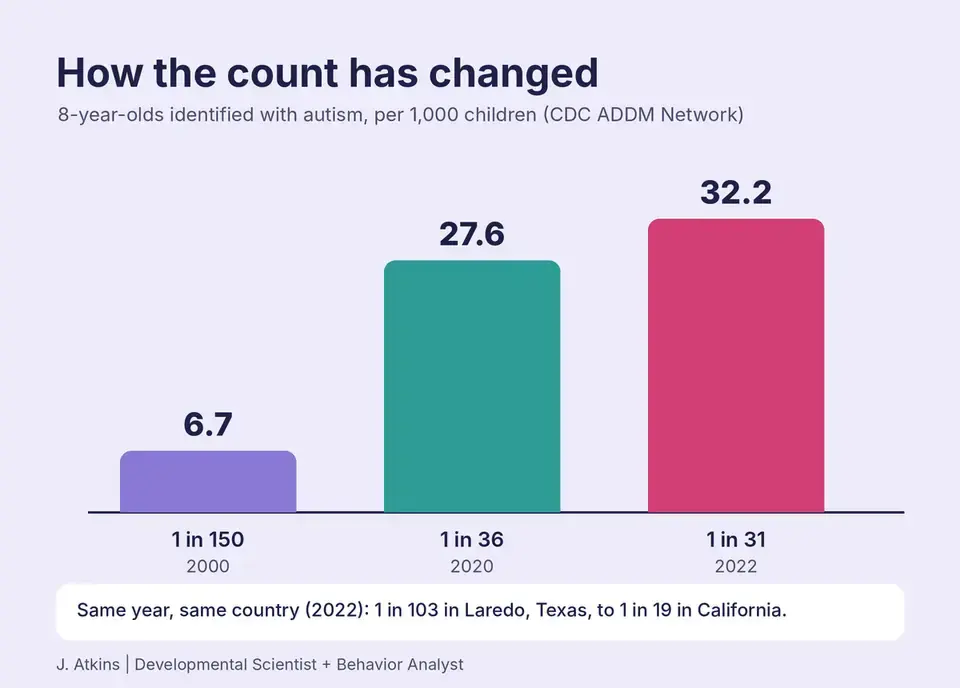
Those numbers can sound alarming. But look at one detail in the same report: in 2022, the rate ranged from 1 in 103 children in Laredo, Texas, to 1 in 19 in California. Children in those two places are not biologically different. What differs is how easily families can get an evaluation and services. The CDC itself says the gaps between communities likely reflect differences in "availability of services for early detection and evaluation and diagnostic practices."
A few other shifts tell the same story:
Earlier identification. Children born in 2018 were 1.7 times as likely to be identified by age 4 as children born in 2014.
Groups once missed are now being counted. Rates are now higher among Asian or Pacific Islander, American Indian or Alaska Native, Black, Hispanic and Multiracial children than among White children, a reversal of the pattern in the earliest reports.
A wider definition. Since 2013, autism has been diagnosed as one spectrum, which includes many children who once would have received another label or none at all.
Much of the rise tells us we are looking harder. It does not, by itself, tell us something new is harming children.
Could some part of the increase be real? Researchers still debate that, and it is a fair question. But the biggest drivers we can measure are awareness, screening and access.
What Causes Autism?
Genes do most of the work
The single best-supported answer is genetics. A 2019 study of more than 2 million children across five countries estimated that about 80% of the variation in autism likelihood is linked to genetic factors, with estimates ranging from roughly 51% to 81% by country. Shared family environment contributed little. That does not mean there is one "autism gene." More than 100 genes are thought to be involved, and current genetic testing finds a clear cause in only about 1 in 5 autistic children.
Two recent studies are changing how researchers think about this:
In 2025, a team studying more than 5,000 children in the SPARK cohort identified four distinct profiles of autism, each with its own genetic pattern. The largest group (about 37%) had typical early milestones, later diagnosis and more co-occurring ADHD or anxiety. The smallest (about 10%) had broad developmental delays and the most new, non-inherited genetic changes. The authors are careful to say this does not mean there are only four kinds of autism.
A 2025 study in Nature found that children diagnosed early (around ages 3 to 6) and those diagnosed after age 10 have partly different genetic profiles. Later-diagnosed autism was more closely tied, genetically, to ADHD, depression and anxiety. The findings still need to be replicated.
What happens before birth
Some prenatal factors do have real support. The clearest example is valproate, a seizure and mood medicine. In a Danish study of 655,615 children, those exposed to valproate in pregnancy had about a 4.4% chance of an autism diagnosis, roughly three times the risk of unexposed children. That is why doctors weigh it carefully for anyone who could become pregnant. More broadly, the National Institutes of Health describes autism as the result of many causes acting together, most often genes interacting with early brain development.

What the evidence does not support
Vaccines
This question has been studied more than almost any other in autism research, across millions of children in many countries. The 1998 paper that started the fear was retracted.
In July 2025, a Danish study of more than 1 million children published in Annals of Internal Medicine looked specifically at aluminum, the vaccine ingredient most often questioned now. It found no association between aluminum-containing vaccines and autism, or 49 other chronic conditions.
You may have seen that in November 2025, the CDC changed its vaccines and autism page. It now says the statement "vaccines do not cause autism" is "not an evidence-based claim," and that the Department of Health and Human Services is running its own assessment. Here is the honest scientific picture. No study can prove a negative with absolute certainty, for vaccines or anything else. What research can do is look hard and repeatedly for a link. It has, for more than 25 years, and the best studies have not found one. If HHS publishes new data, it deserves the same scrutiny as every study before it.
Acetaminophen (Tylenol) in Pregnancy
In September 2025, federal officials announced that acetaminophen use in pregnancy may be linked to autism and advised using it only when needed, pointing to studies that found associations. The key word is association. Families who use more acetaminophen can differ in many ways, including their own genes, health conditions and the fevers or infections that led them to take it. The strongest way to test cause is to compare siblings, since they share much of their genes and home life.
A 2024 Swedish study of nearly 2.5 million children found a very small association across the whole population. When siblings were compared, it disappeared.
A January 2026 review in The Lancet Obstetrics, Gynaecology & Women's Health of 43 studies, weighted toward sibling designs, found no link with autism, ADHD or intellectual disability.
A 2026 study in JAMA Internal Medicine using sibling and negative-control analyses found no causal link.
In September 2026, an umbrella review of seven meta-analyses covering more than 3 million participants found a 17% higher autism rate in the raw data that disappeared when only high-quality studies were included. Its authors concluded that paracetamol, another name for acetaminophen, "remains an appropriate first-line treatment during pregnancy when clinically indicated."
The American and British colleges of obstetricians and the European Medicines Agency still recommend it as the first choice for pain and fever in pregnancy. Untreated high fever carries its own risks, so if you are pregnant, keep that conversation with your own clinician.
Leucovorin as an Autism Treatment
At the same September 2025 announcement, officials promoted leucovorin, a form of folate, as an autism treatment. In March 2026, the FDA's approval actually covered something much narrower: a rare genetic condition called cerebral folate deficiency, which affects about 1 in a million people. The trials in autism have been small, one of the largest was retracted, and experts call the evidence weak. Even so, a study in The Lancet found new leucovorin prescriptions for children rose 71% within months. Larger, better-designed trials are still needed. Until then, it is not an established autism treatment.
Early Signs and Diagnosis
Autism can sometimes be detected at 18 months or younger, and by age 2, a diagnosis from an experienced professional is considered very reliable. The American Academy of Pediatrics recommends autism screening at the 18- and 24-month checkups for every child. Yet the typical child in the CDC report was not diagnosed until 47 months, almost 4 years old, and in some communities closer to 6.
Signs the CDC lists include a child who:
Does not respond to their name by 9 months
Uses few or no gestures, like waving, by 12 months
Does not point to show you something interesting by 18 months
Does not notice when others are hurt or upset by 2 years
Lines up toys, repeats words or phrases, flaps hands, or reacts strongly to small changes or certain sounds and textures
One sign alone is not a diagnosis. But if you notice a pattern, you do not need to "wait and see." Ask for a screening and, if needed, a referral. Early support can begin while you wait for a full evaluation.
Girls and Adults are still being missed
In the CDC data, boys were identified about 3.4 times as often as girls. That gap is probably wider than the true difference. A major review found the ratio shrinks to about 3 to 1 in studies that actively screen everyone, rather than counting only children already diagnosed. Many autistic girls learn to camouflage, or mask, their differences, and our diagnostic criteria were shaped largely around boys. Adults are missed too. The CDC estimates that about 2.2% of U.S. adults, roughly 5.4 million people, are autistic. Many reach adulthood without ever being diagnosed.
Autism rarely travels Alone
Co-occurring conditions are common, and they often shape daily life as much as autism itself. A large 2019 analysis estimated that among autistic people:
28% have ADHD
20% have an anxiety disorder
13% have a sleep disorder
11% have depression
In the CDC report, about 40% of autistic 8-year-olds with IQ scores available also had an intellectual disability. Epilepsy and gastrointestinal problems are also more common. When an autistic child struggles with sleep, attention or worry, these deserve their own evaluation and treatment, not just the assumption that "it's the autism."
What Actually Helps
The largest review of early autism supports, Project AIM, pooled 252 studies with more than 13,000 young children. Its findings are worth knowing:
Naturalistic developmental behavioral interventions (NDBIs) blend behavioral science with child-led play in everyday routines, with parents often trained as partners. In randomized trials they showed the broadest positive effects, on language, play, social communication and daily living skills.
Developmental approaches also improved social communication.
Traditional, intensive behavioral programs showed benefits for social-emotional and challenging behavior, but the effect faded when ratings by parents or teachers were set aside.
Across all approaches, effects shrank when the most bias-prone measures were removed. Promising is not the same as proven.
Sensory-based, animal-assisted and some other popular approaches had too few controlled studies to judge.
The review also raised a hard truth about the whole field. Nearly two thirds of the measured outcomes were at risk of bias because assessors knew which children got the intervention. And possible harms were rarely tracked. That is not a reason to avoid support. It is a reason to ask good questions about it.
A behavior analyst's honest take on ABA
I am a behavior analyst, so I want to speak directly to the debate around Applied Behavior Analysis (ABA). Many autistic adults have described early ABA programs that aimed to make children look "indistinguishable" from their peers, suppressed harmless stimming, and rewarded compliance over comfort. Some describe lasting harm. A 2025 article by an autistic behavior analyst puts it plainly: those practices prioritized "neurotypical conformity" over autistic people's autonomy and well-being, and the field needs to listen.
The same author also writes that "at its core, ABA is not inherently harmful." I agree. The science of how behavior and learning work is a tool. What matters is the goals it serves and how it is used. Since 2022, the ethics code for certified behavior analysts has required us to treat clients "with compassion, dignity, and respect" and to seek a child's assent, their willingness to take part, when applicable.
If you are considering any support program, behavioral or not, here is what to look for:
Goals that serve your child, like communication, safety, independence and joy.
Assent, meaning sessions pause or change when your child shows distress or wants to stop.
Room for harmless stims and interests, which often help a child regulate.
Play and everyday routines, with you involved and taught the strategies.
Clear data, shared with you, and openness to changing course.
Respect for autistic voices, including your child's own as they grow.
What this means for your family
Here is where the science stands in 2026. Autism is common, mostly genetic, and present from early development. Its rising numbers largely reflect that we are finally seeing children we used to miss. The best evidence does not support vaccines or acetaminophen as causes. And the most promising support is early, playful, family-centered and respectful of who your child is.
You do not need to have every answer to start. If something feels different about how your child is developing, trust that instinct and ask for a screening. And if your child is already autistic, the most powerful thing you can offer is the same as for any child: understanding, the right supports, and the belief that they can thrive as themselves.


Comments